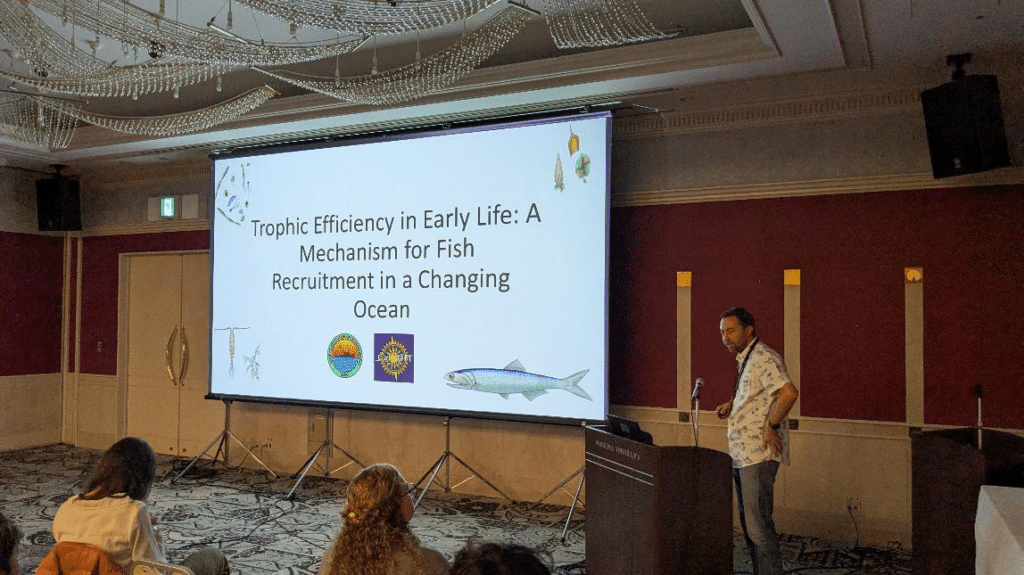
In November, I was invited to speak about my CalCOFI research on the Trophic Efficiency in Early Life Hypothesis at the 2025 PICES meeting in Yokohama, Japan. This talk was part of a session on “Applying Innovative and Established Approaches to Assess the Resilience of the Early Life Stages of North Pacific Fishes to Changing Oceanographic Conditions”.
This work was initially centered on the Northern Anchovy in Southern California using samples and data which has been collected by CalCOFI for the past 76 years. Here, we were able to show that the dramatic population boom and bust cycles which are characteristic to anchovy was related to the efficiency by which energy is transferred from the base of the food chain up to larval anchovy, the most vulnerable period in an anchovy’s life. Since anchovy is responsible for transferring much of the energy from the plankton to higher trophic levels like seabirds, whales, sea lions and large fishes these boom-and-bust cycles reverberate through the entire ecosystem and impact fisheries. Understanding what drives these cycles to occur is thus important for forecasting and management.
Facets of this emerging hypothesis has since been tested on Shortbelly Rockfish, another but very different inhabitant of Southern California, and on Atlantic Bluefin Tuna, Southern Bluefin Tuna and Albacore tuna which spawn in the Atlantic and Indian Ocean. Despite inhabiting very different types of marine ecosystems their larval stages all share a common ecological mechanism: they all grow and survive better when feeding on prey that maximize energy transfer efficiency, and in the case of bluefin tunas they will actively select those prey over others.
By combining long-term CalCOFI monitoring data with ecosystem process studies, we’re gaining a better understanding of how ocean changes impact fish populations and how we can improve ecosystem-based fisheries management. The presentation also touched on the importance of long term monitoring for assessing pollution impacts over time, such as the recently re-discovered DDT dumping sites in the Southern California Bight.